Business strategy, tax efficiency, and value creation
By Marli Voss Hartmann da Silva
What is corporate reorganization?
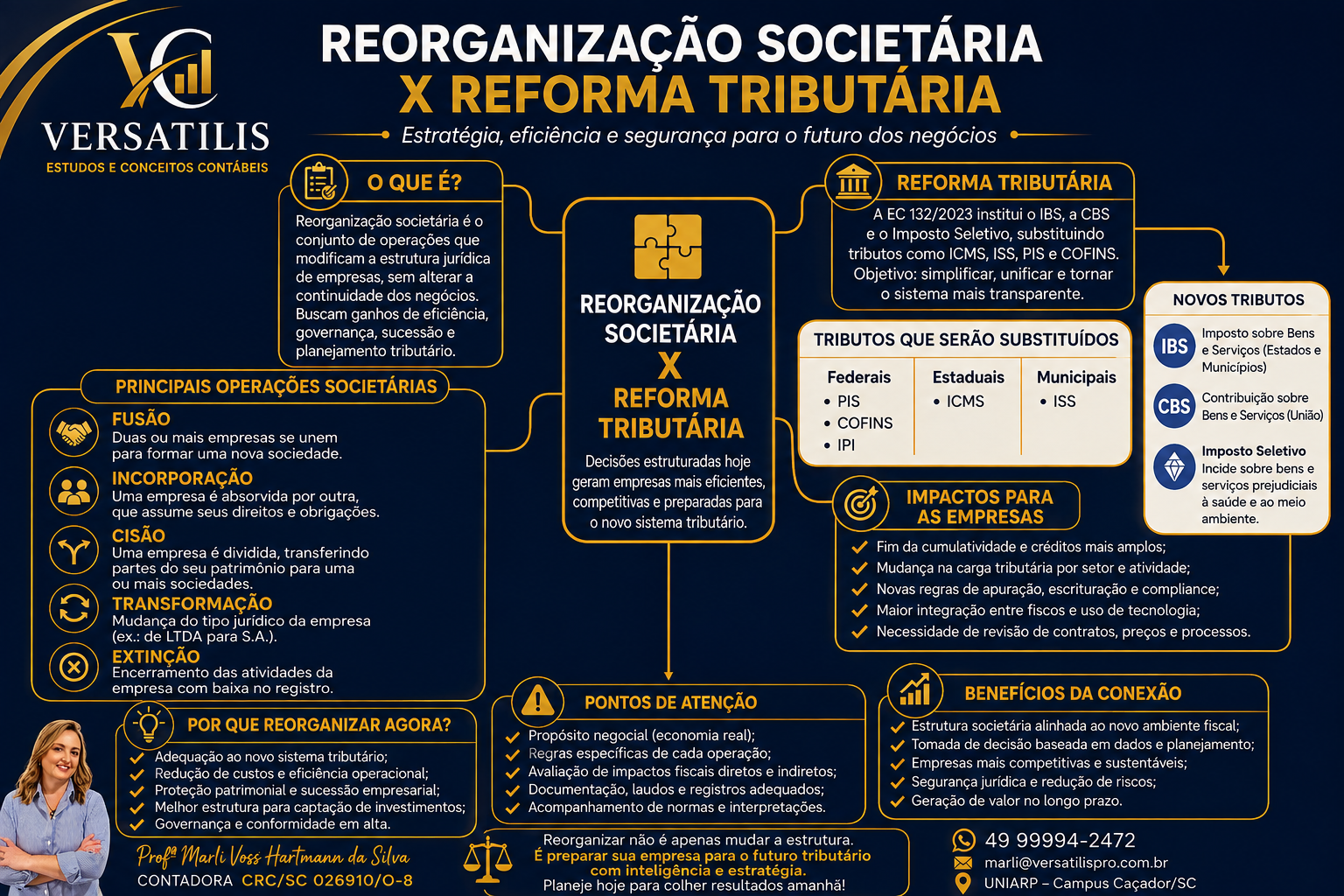
Corporate reorganization is the set of operations provided for mainly in Law No. 6,404/1976 and in the Civil Code that changes the legal structure of companies without necessarily interrupting their activities. Among the most used modalities are incorporation, merger, spin-off, and corporate transformation.
2. Reforma Tributária and its impacts
The implementation of IBS, CBS, and the Selective Tax changes the way taxes on consumption are levied. Although the reform aims to simplify the system, several economic groups will need to review corporate structures to reduce operational costs, avoid undue cumulativity, optimize logistics flows, and adjust internal processes.
3. When can reorganization be a strategy?
Companies with multiple activities, branches, family holdings, interstate operations, or a high volume of transactions may consider reorganizations to improve governance, separate risks, facilitate succession, concentrate operations, and prepare for the new tax environment. Every transaction must have a true business purpose and cannot be carried out solely for tax savings.
4. Practical example
A company has industry, commerce, and service provision in the same legal entity. After an economic study, it is identified that separating the activities through a partial spin-off allows greater managerial control, better cost calculation, specific governance for each business, and more efficient adaptation to the IBS and CBS rules. The reorganization will only be valid if it demonstrates an effective business purpose.
5. Accounting aspects
Reorganization operations must comply with Law No. 6,404/1976 and the applicable Accounting Pronouncements, especially CPC 15 (R1) – Business Combinations, CPC 18 (R2) – Investment in Associates, Subsidiaries and Joint Ventures, CPC 36 (R3) – Consolidated Financial Statements, and CPC 46 – Fair Value Measurement, when applicable. The accounting treatment will depend on the nature of the transaction and its economic substance.
6. Care
Abusive tax planning can be disregarded by the tax administration when simulation or lack of business purpose is characterized. Therefore, reorganizations must be grounded in economic, legal, accounting, and tax studies.
Final Considerations
The Reforma Tributária represents an opportunity to review business structures. Corporate reorganization should not be seen only as a mechanism for tax savings, but as a tool for management, competitiveness, and sustainable value creation. Companies that plan their changes in advance will be better prepared for the new business environment.
References
·
BRAZIL. Law No. 6,404/1976 – Corporations Law.
·
BRAZIL. Constitutional Amendment No. 132/2023.
·
Complementary Law No. 214/2025.
·
CPC 15 (R1), CPC 18 (R2), CPC 36 (R3), CPC 46.
·
CFC – Brazilian Accounting Standards.