Essential concepts for business management
By Marli Voss Hartmann da Silva
Versátilis Accounting Studies and Concepts
Introduction
Understanding the financial position of a company is essential not only for accounting professionals, but also for managers, administrators, and entrepreneurs. Decisions related to investments, debt, asset acquisition, and the use of available resources depend on information that can demonstrate the economic and financial reality of the organization.
In this context, net worth, assets, liabilities, and equity are essential concepts for interpreting financial statements. Accounting transforms economic events into structured information, and for managers, understanding this language expands their ability to analyze the company and make informed decisions.
Equity: far beyond the company's assets
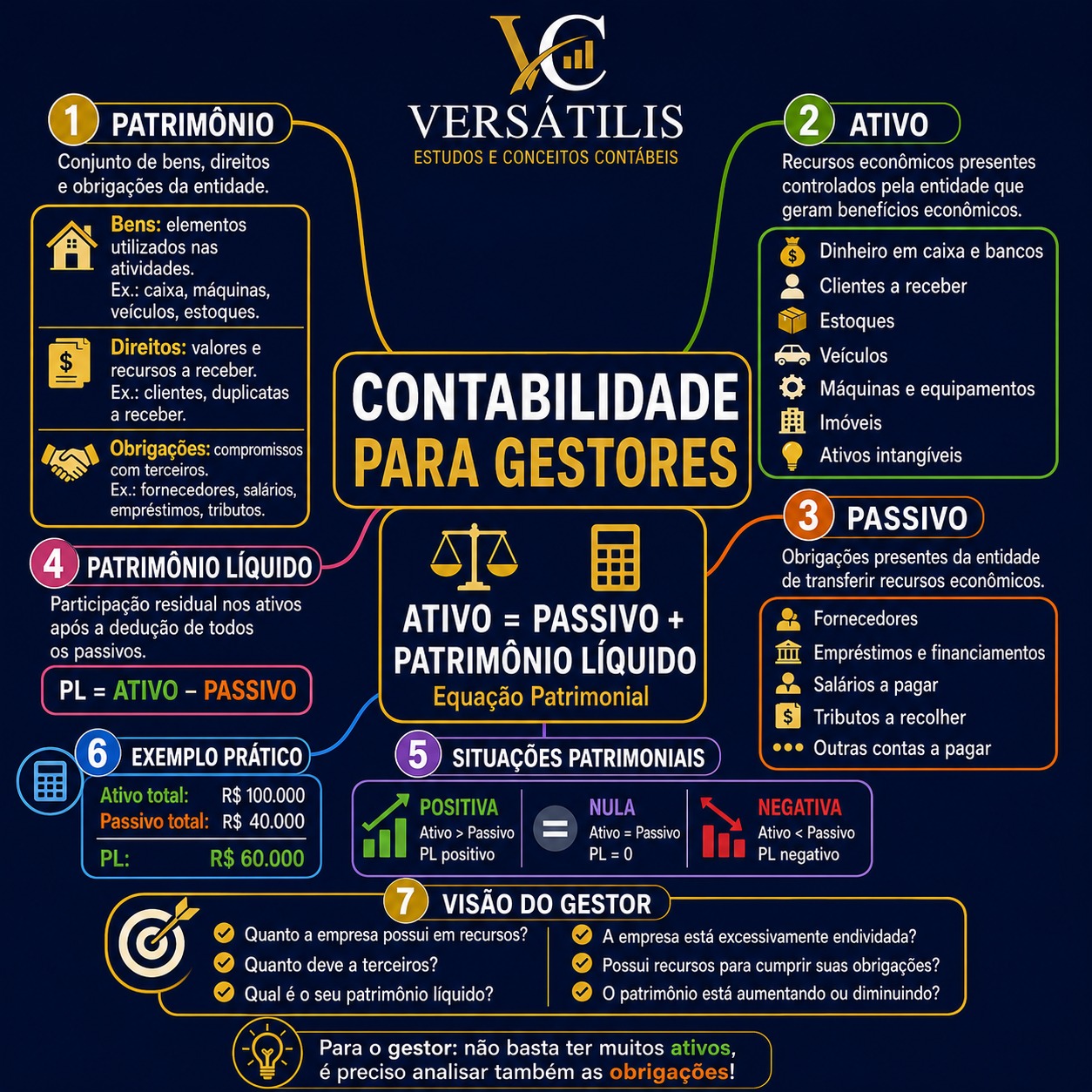
In an introductory approach, business equity can be studied from three elements: assets, rights, and obligations. Assets comprise elements used by the organization in the development of its activities, such as money, merchandise, machines, equipment, vehicles, and real estate.
Rights correspond, in didactic terms, to the values and resources the company has to receive, such as credit sales and certain credits from third parties. Obligations represent commitments assumed by the entity, such as amounts owed to suppliers, financial institutions, employees, and governments.
PATRIMONY → GOODS + RIGHTS + OBLIGATIONS
To understand these elements according to the contemporary conceptual framework of Accounting, it is necessary to move on to the concepts of assets, liabilities, and equity, established by CPC 00 (R2).
2. Assets: the entity's economic resources
According to CPC 00 (R2) – Conceptual Framework for Financial Reporting, an asset is a present economic resource controlled by the entity as a result of past events. The economic resource is a right that has the potential to produce economic benefits.
In business practice, elements such as cash, funds held in financial institutions, accounts receivable, inventories, machinery, vehicles, real estate, and certain intangible assets may be related to assets, provided the applicable requirements are met.
For the manager, analyzing the asset means understanding the economic resources that sustain the organization's activities and that can contribute to the generation of economic benefits.
3. Liabilities: understanding obligations is also managing.
CPC 00 (R2) defines a liability as a present obligation of the entity to transfer an economic resource as a result of past events. Examples found in everyday business include accounts payable to suppliers, loans, financing, salaries, and certain tax obligations.
This concept is especially important for management because a company can present a significant volume of assets and, simultaneously, have significant obligations. Thus, analyzing only what the company owns or controls is not enough to understand its equity position.
4.
Shareholders' Equity: the residual interest
Equity represents the residual interest in the assets of the entity after deducting all its liabilities, as established by CPC 00 (R2).
NET EQUITY = ASSETS − LIABILITIES
Imagine a company with Assets of R$ 500,000.00 and Liabilities of R$ 320,000.00. In this case, the Shareholders' Equity will be R$ 180,000.00. This shows that total assets do not necessarily correspond to the organization's equity.
5. The Accounting Equation
One of the fundamental relationships for understanding the equity structure is the equation that relates Assets, Liabilities, and Net Equity.
ASSETS = LIABILITIES + EQUITY
Consider a company with R$ 20,000.00 in cash, R$ 30,000.00 in accounts receivable, R$ 50,000.00 in inventories, and R$ 100,000.00 in machinery and equipment. Its total assets will be R$ 200,000.00.
If this same company has R$ 40,000.00 in suppliers and R$ 30,000.00 in loans, it will have liabilities of R$ 70,000.00. Consequently, its net equity will be R$ 130,000.00.
R$ 200,000.00 = R$ 70,000.00 + R$ 130,000.00
6. A comparison with personal finances.
A simple way to understand this relationship is to bring it into a family's reality. Imagine a residence of R$ 300,000.00, a vehicle of R$ 80,000.00, and R$ 20,000.00 available in a bank account. For educational purposes, these resources total R$ 400,000.00.
If there are still R$ 180,000.00 related to home financing and R$ 30,000.00 related to vehicle financing, the obligations total R$ 210,000.00. The difference is R$ 190,000.00.
The comparison highlights an important idea for any manager: having many resources does not, by itself, mean having a favorable financial position. It is necessary to analyze assets, liabilities, and equity together.
7. From Accounting to Decision-Making
When managers understand the equity structure, they stop viewing Accounting as merely a set of records and start using it as an analysis tool. Matters such as resource volume, level of obligations, indebtedness, equity participation, and asset evolution become part of decision-making.
The figures presented in the
financial statements tell part of the organization's economic story. Interpreting them
allows managers to better understand the company's structure, assess risks, and
support decisions with more consistent information.
Final Considerations
Assets, liabilities, and equity are basic Accounting concepts, but they are highly relevant to business management. Understanding the accounting equation allows you to visualize the relationship between the entity's economic resources, its obligations, and the residual interest represented by equity.
More than memorizing that Assets = Liabilities + Equity, it is necessary to understand the managerial meaning of this relationship. Accounting becomes even more useful when it is no longer seen merely as an administrative obligation and is instead interpreted as a source of information for understanding the company, assessing its structure, and supporting decisions.
VERSÁTILIS STUDIES AND ACCOUNTING CONCEPTS
Simplifying accounting concepts to turn information into knowledge and knowledge into decisions.
References
BRAZIL. Law No. 6,404, of December 15, 1976. Provides for Corporations.
ACCOUNTING PRONOUNCEMENTS COMMITTEE – CPC.
CPC 00 (R2) – Conceptual Framework for Financial Reporting. Brasília: CPC.
FEDERAL ACCOUNTING COUNCIL – CFC. NBC TG Conceptual Framework – Conceptual Framework for Financial Reporting. Brasília: CFC.