
Technical article with practical examples
Marli Voss Hartmann da Silva
Updated September 2026
Organizing numbers is organizing dreams.
Executive summary
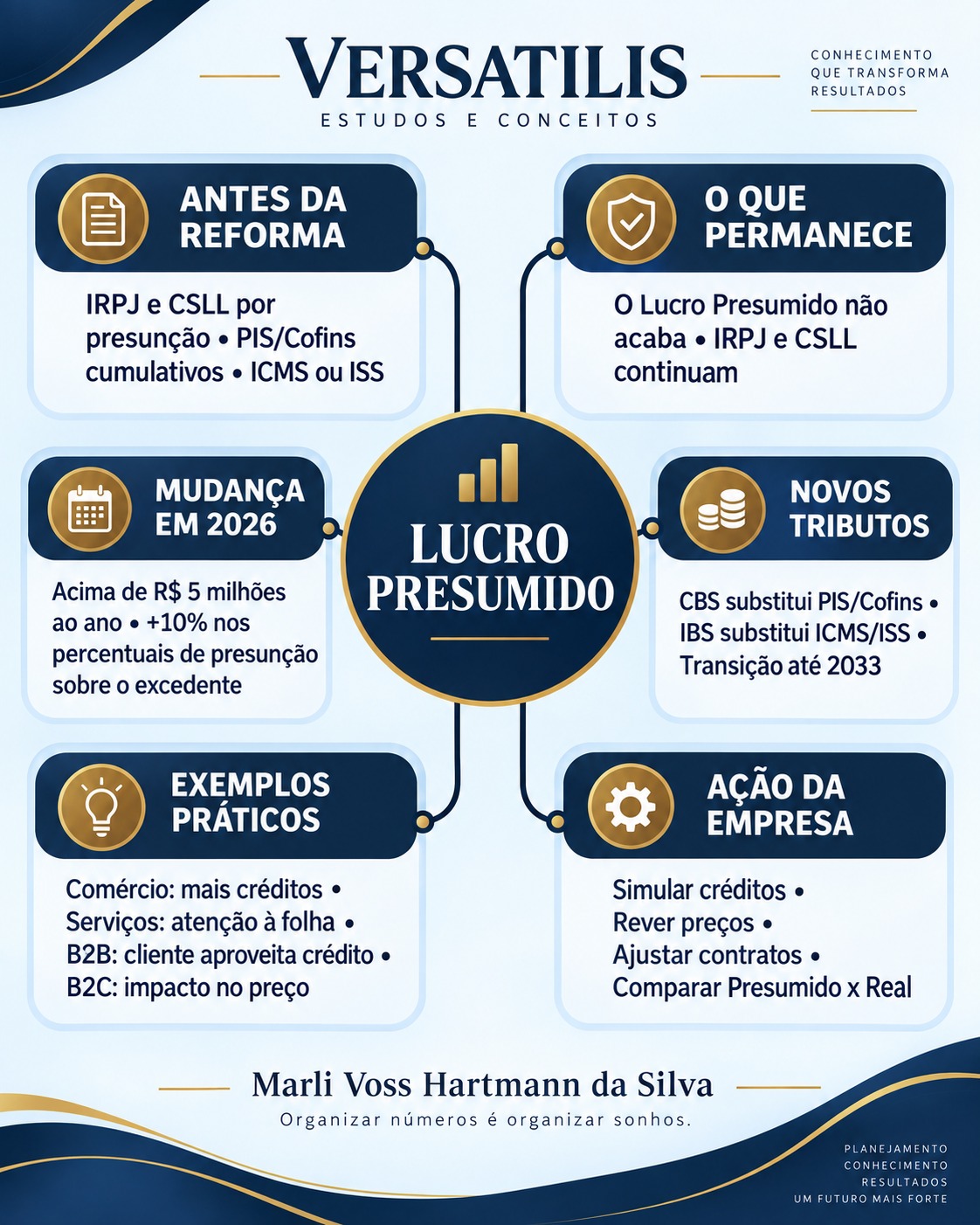
Lucro Presumido was not extinguished by the Reforma Tributária. The way IRPJ and CSLL are calculated remains based on presumption percentages, but since 2026 there is an additional change for companies with annual gross revenue above R$ 5 million: Complementary Law 224 of 2025 increased the presumption percentages by 10%, applicable only to the portion exceeding that limit.
The great transformation occurs in the taxation of consumption. PIS and COFINS will be replaced by CBS, while ICMS and ISS will be gradually replaced by IBS. The new model is non-cumulative and allows broader credits, so the real impact will depend less on the name “Lucro Presumido” and more on the composition of purchases, expenses, investments, customers, and prices of each company.
Main conclusion: the choice between Lucro Presumido and Lucro Real must be reassessed with simulations. Service companies with few credits may feel greater pressure; businesses with significant purchases and investments tend to make better use of non-cumulativity. The B2B or B2C relationship also becomes decisive.
What is Lucro Presumido?
Lucro Presumido is a regime for calculating IRPJ and CSLL. Instead of starting from adjusted accounting profit, the legislation applies percentages to gross revenue to estimate the taxable base. In general, commercial activities use 8% for IRPJ and 12% for CSLL; many services use 32% for both. There are specific percentages and rules for other activities.
As a rule, the presumed base is subject to IRPJ of 15%, an additional 10% on the portion of the base exceeding R$ 20,000 per month of the assessment period, and CSLL of 9%. Until the complete replacement of consumption taxes, PIS, COFINS, ICMS, ISS and, when applicable, IPI also coexist.
Before and after at a glance
|
Topic |
Before the Reform |
After the Reform and transition |
|
IRPJ and CSLL |
Bases calculated by presumption percentages. |
They remain; from 2026 there is a 10% increase in the presumption on the annual portion above R$ 5 million. |
|
PIS
and Cofins |
Generally cumulative under Lucro Presumido, totaling 3.65%, with limited credit. |
Replaced by CBS, with non-cumulativity and credits as per legislation. |
|
ICMS and ISS |
State or municipal collection, with distinct rules and credits. |
Gradual replacement by IBS, charged at destination and non-cumulative. |
|
Price |
Taxes often embedded in the price. |
IBS and CBS are charged separately, requiring revision of contracts and margins. |
|
Tax decision |
Focus on revenue, presumed margin, and current tax burden. |
Includes credit profile, chain, B2B or B2C client, cash, and transition. |
The 2026 change in Lucro Presumido itself
Complementary Law 224 of 2025 treated Lucro Presumido as a favored regime and determined a 10% increase in the presumption percentages. However, this increase applies only to the portion of total gross revenue exceeding R$ 5 million in the calendar year, with proportional application to the assessment periods and the revenues of each activity.
This does not mean adding ten percentage points. A percentage of 32% becomes 35.2% on the excess portion, since 32% × 1.10 = 35.2%. Likewise, 8% becomes 8.8% and 12% becomes 13.2%.
Practical example 1: service company above R$ 5 million
Consider a consultancy with annual revenue of R$ 6 million, regularly distributed, and traditional presumption of 32% for IRPJ and CSLL. For didactic purposes, other revenues and adjustments are disregarded.
|
Revenue bracket |
Percentage |
Presumed basis |
|
Up to R$ 5,000,000 |
32.0% |
R$ 1,600,000 |
|
Excess of R$ 1,000,000 |
35.2% |
R$ 352,000 |
|
Total |
— |
R$ 1,952,000 |
Without the new rule, the annual base would be R$
1,920,000. The difference of R$ 32,000 increases IRPJ and CSLL. Assuming uniform
revenue and four quarterly assessments, the entire difference remains above the
additional threshold: the annual increase would be R$ 8,000 in IRPJ, including the
additional amount, and R$ 2,880 in CSLL, totaling R$ 10,880.
How the transition of consumption taxes works
|
Period |
Main change |
|
2026 |
Test year: CBS at 0.9% and IBS at 0.1%, with compensation mechanisms provided for in the legislation. |
|
2027 and 2028 |
CBS takes full effect; PIS and COFINS are abolished. The Selective Tax comes into force and IPI is reduced, with exceptions preserved. |
|
2029
to 2032 |
ICMS and ISS are gradually reduced while IBS increases. |
|
2033 |
IBS and CBS operate fully; ICMS and ISS cease to apply. |
The definitive reference rates must be observed in the legislation applicable to each period. Therefore, examples with a combined rate of 26.5% are educational simulations, not a promise of final tax burden.
Practical example 2: commerce with relevant credits
A commercial company invoices R$ 300,000 in the quarter and purchases R$ 180,000 in goods. To compare the logics, assume ICMS of 18% in the previous model and IBS plus CBS of 26.5% in the final scenario. Benefits, tax substitution, freight, expenses, returns, or specific regimes are not considered.
|
Calculation |
Before |
Final simulated scenario |
|
Debit on sales |
ICMS R$ 54,000 |
IBS and CBS R$ 79,500 |
|
Credit on purchases |
ICMS R$ 32,400 |
IBS and CBS R$ 47,700 |
|
Consumption balance |
R$ 21,600 |
R$ 31.800 |
|
Corporate Income Tax (IRPJ) |
R$ 3,600 |
R$ 3,600 |
|
Social Contribution on Net Profit |
R$ 3,240 |
R$ 3,240 |
|
PIS
and Cofins |
R$ 10,950 |
Replaced by CBS |
|
Comparable total |
R$ 39.390 |
R$ 38,640 |
Reading the example: the simulated tax burden is close because purchases generate relevant credits. If the company invests in equipment, technology, or services eligible for credits, the result may change. Lucro Presumido remains for IRPJ and CSLL; the new credit logic belongs to IBS and CBS.
Practical Example 3: Service Provider with Few Credits
A consulting firm invoices R$ 300,000 in the quarter and has only R$ 30,000 in acquisitions that generate credits. Consider ISS of 5% in the previous model and IBS plus CBS of 26.5% in the final simulated scenario.
|
Calculation |
Before |
Final simulated scenario |
|
PIS
and Cofins |
R$ 10,950 |
Replaced by CBS |
|
ISS or net IBS and CBS |
ISS R$ 15,000 |
R$ 79,500 minus R$ 7,950 = R$ 71,550 |
|
IRPJ with additional |
R$ 18,000 |
R$ 18,000 |
|
Social Contribution on Net Profit |
R$ 8,640 |
R$ 8,640 |
|
Comparable total |
R$ 52,590 |
R$ 98,190 |
Reading the example: a labor-intensive company may have few credits, because wages do not generate IBS and CBS credits. The apparent increase should not be read in isolation: in the new model, the tax is stated separately, contracts can be renegotiated, certain activities may have rate reductions, and business clients can take the credit. Even so, services with a low volume of inputs require special attention.
Practical example 4: B2B and B2C impact
B2B: a consulting firm sells to another taxpayer company. Even with IBS and CBS shown separately, the client can take credit when legal requirements are met. This reduces economic resistance to the tax and makes fiscal transparency a commercial advantage.
B2C: the same consultancy sells to the final consumer. Since the consumer does not take advantage of credits, the final price tends to feel the burden more directly. The company will need to decide how much to pass on, how much to absorb in the margin, and how to reposition its service.
Practical example 5: investment in equipment
A company acquires equipment worth R$ 200,000. Assuming, only for simulation, IBS and CBS combined at 26.5%, the potential credit would be R$ 53,000, subject to legal rules, tax disclosure, and appropriation conditions. In the previous system, recovery could be limited, fragmented, or occur over different periods. In the new model, tax relief on capital goods and broad credit can favor companies that invest.
What changes in management and accounting
Tax registration. Products, services, clients, and suppliers must be correctly classified for tax rates, reductions, and specific regimes.
Tax documents. The highlight of IBS and CBS and the new information require prepared systems and constant verification.
Accounts payable. The supplier's tax quality influences the credit and the effective cost of the purchase.
Pricing. Price, tax on top, margin, and customer credit must be analyzed together.
Cash flow. The timing of collection, appropriation, and reimbursement of credits changes the need for working capital.
Contracts. Net price clauses, tax pass-through, and legislative-change review deserve updating.
Tax planning.
Lucro Presumido, Lucro Real, and Simples Nacional should be compared with real data, not just nominal rates.
When Lucro Presumido can continue to be advantageous
The regime can remain interesting when the effective margin exceeds the presumed margin, the activity is permitted, the company stays within the legal revenue limit, and the simplified calculation generates savings compared to Lucro Real. The analysis must consider the IRPJ surcharge, the 2026 rule for revenues above R$ 5 million, the payroll, sectoral benefits, and the credit profile of IBS and CBS.
It may lose attractiveness when the actual margin is lower than the presumed one, there are losses or significant fluctuations, the service company has few credits, or the commercial chain requires a different structure. The best choice is not permanent: it should be reviewed before each calendar year and whenever the business model changes.
Practical guide for companies
1.
Separate revenue by activity, state, municipality, customer type, and applicable regime.
2.
Map purchases, expenses, and investments that can generate IBS and CBS credits.
3.
Simulate 2026, each stage of the transition, and the 2033 scenario.
4.
Compare Lucro Presumido and Lucro Real while keeping the operational premises the same.
5.
Recalculate prices for B2B and B2C customers and test the effect on margin.
6.
Review contracts, systems, fiscal documents, registrations, and working capital.
7.
Update the simulation when applicable rates and regulations are published.
Conclusion
The Tax Reform does not eliminate Lucro Presumido, but it profoundly changes the environment in which it operates. IRPJ and CSLL remain, with special attention to the increase in presumed profit percentages on annual revenue exceeding R$ 5 million. At the same time, IBS and CBS replace consumption taxes and bring broad credits, destination-based taxation, and separate disclosure.
For some companies, especially those that accumulate credits, the change can improve neutrality. For others, particularly labor-intensive service providers with end consumers, the pressure on price and margin may be greater. The right answer will come from individual simulations, carried out with reliable accounting and tax data.
Legal and institutional references
·
Constitutional Amendment 132 of 2023
·
Complementary Law 214 of 2025
·
Complementary Law 224 of 2025
Note: the examples are educational, use
simplified assumptions and do not replace individual tax analysis.
Rates, reductions, credits, specific regimes and obligations must be
confirmed for the activity and the assessment period.